Pankaj Jha, a medium-level officer in the Indian army, shot himself with a service revolver earlier this month. He was 38.
Nobody quite knows why Lt Col Jha pulled the trigger on himself - he had been serving in the military for the past 14 years. According to his mother, Lalita Jha, "there was no tension, no problems. I just can't understand why he did it".
He is far from the only soldier to take his own life this year - Capt Sunit Kohli, Maj Sobha Rani, Lt Sushmita Chatterjee... the list goes on.
In fact, the Indian army is losing more soldiers in these incidents than in action against the enemy.
The army has lost 72 soldiers to enemy attacks so far this year. But over 100 soldiers have already taken their lives. In addition, another 32 have been killed by their colleagues.
What is happening to the army?
DISTURBING TREND
Since 2004, 282 soldiers have been killed in militant attacks
Since 2004, 408 soldiers have taken their lives, killed colleagues or died after colleagues ran amok
Of the 408 soldiers, 333 killed themselves
The million-strong force is clearly under tremendous stress.
Though it has not fought a full-blown war in decades, the force is bogged down in fighting domestic insurgencies, guarding restive borders and sometimes quelling civilian rioting.
Most experts attribute the growing stress to low morale, bad service conditions, lack of adequate home leave, unattractive pay and a communication gap with superiors.
Retired Maj Gen Afsar Karim, who has fought three wars, says that the stress may be high among soldiers because of lack of leave.
Indian soldier in Kashmir
The army is involved in quelling several local insurgencies
"The army is involved in a [difficult] long running internal security environment. There is lack of rest and they get very little leave. Lack of leave increases his stress," he says.
"Soldiers get angry when they are denied leave and their officers themselves take time off. It triggers a reaction, they are well armed and they take their own lives.''
Then there is the question of what many say is low pay - starting salaries in many jobs in middle-class India are double that of a new soldier, and for many of them the army no longer holds out the promise of a good life.
Retired Maj Gen Karim suspects that with the increase in numbers of soldiers, cohesiveness is being eroded.
"In our times, we used to know the names of our soldiers, where they came from. We used to meet their families, but now the army has expanded manifold and this cohesiveness is gone," he says.
Frayed nerves
The army says it is worried about this disconcerting trend.
Spokesman Col SK Sakhuja says soldiers kill each other when one of them perceives that they are being harassed by superiors or when they have heated arguments among themselves.
''We have strengthened formal and informal interaction between soldiers and officers. Leave policy, especially for soldiers posted in difficult areas, has been liberalised so that a soldier can go home to sort out his domestic problems," he says.
"Also, counselling by officers, psychiatrics and religious teachers is being undertaken.''
Delhi-based psychiatrist Achal Bhagat says a combination of stress and high alcohol consumption could lead to frayed nerves.
Yoga classes for soldiers in Kashmir
The army says it is holding classes to relieve stress
"What is needed is confidential counselling, creating a support system for the soldiers working in adverse conditions," he says.
The army is confident that this is a "testing time" for the force and it will pass.
"Our foundations are strong," says Col Sakhuja.
The problem is that there is not enough clarity still on what precisely is causing these soldier deaths.
Lalita Jha, mother of Pankaj Jha, hopes that she will find out more about her son's suicide.
"I am sure the army will look into the matter and find out what happened," she says.
Before more soldiers take their lives, one hopes.
Sunday, December 24, 2006


Friday, December 22, 2006


Monday, December 11, 2006
Islam's Golden Age
By Dr Farrukh Saleem
Rabbi Shmuel HaNagid, the great Jewish poet and warrior, was appointed
the prime minister of Muslim Spain by the caliph of Cordoba (himself a
successor of General Tariq bin Ziyad). That was 935 years ago. Can the
president of the Islamic Republic of Pakistan dare send a non-Muslim to
the prime minister's office?
Sultan Saladin, the twelfth century century Muslim warrior, appointed
Rabbi Moses Maimonides, the great Jewish philosopher and surgeon, as his
personal physician. Sultan Saladin went on to rule Egypt, Syria, Yemen
and Iraq.
The four secrets to Islam's Golden Age were tolerance, merit, talent
and freedom to dissent. Based on merit, a Jew was appointed the prime
minister (religious beliefs of a citizen did not matter, talent did).
Other faiths were respected and citizens had the freedom to dissent.
Consider Abd al-Rahman III, caliph of Cordoba. Abd al-Rahman was in
love with books. Muslim Cordoba had 70 libraries. Just how many libraries
have been built by General Mohammed Yahya Khan, General Mohammed
Zia-ul-Haq, Ghulam Ishaq Khan, Benazir Bhutto, Mian Nawaz Sharif, Farooq
Ahmed Khan Leghari and General Pervez Musharraf all put together? Abd
al-Rahman's library had 44 volumes in the catalogue for the 400,000 volumes.
A thousand years hence and the National Library of Pakistan has a mere
130,000 books.
A rabbi was made the prime minister a thousand years ago and now we
disown Abdus Salam the only Noble Laureate this county ever produced (Dr
Salam was buried in Rabwah without any official protocol). No wonder the
caliph of Cordoba ruled over Spain, Portugal, Morocco, Algeria, Tunisia
and Libya while we are left with half of what we started out with.
Imagine, some 1200 years ago Jews of Cordoba, Malaga, Granada, Seville
and Toledo had welcomed Muslim conquerors (because they were being
persecuted by the Christians). When Muslims conquered Cordoba, Malaga,
Granada, Seville and Toledo they appointed Jewish administrators. Anyone
who had talent; Jews were appointed top diplomats, royal physicians,
viziers and statesmen. Christian scholars were called in as the caliph's
translators.
Ummayad al-Hakam II, another caliph of Cordoba and another book lover,
first made peace with Christian kingdoms around him and then attracted
scholars -- Muslims, Christians and Jews -- from Asia as well as from
Africa to come to Cordoba and translate books from Latin and Greek into
Arabic (Muslim Saudi Arabia has translated fewer books in the past 50
years than does Spain in a year).
Islam's Golden Age thrived on respect of other faiths, appointments on
merit and love of books. When we respected other religions and loved
books we ruled over North Africa, Nimes (France), Sicily (Italy),
Walachia (Romania), Cypress, Sardinia, Serbia, Bosnia and Herzegovina,
Albania, Venice, Hungary, Algeria, Egypt, Libya, Morocco, Sudan, Tunisia,
Mauritania, Mali, Niger, Chad, Ethiopia, Eritrea, Djibouti, Iran and all
the way to Pakistan.
We no longer respect other religions and hate books (there are 800
million illiterate Muslim men and women in 57 Muslim-majority OIC member
states). As a consequence, Muslims are 22 per cent of humanity but
produce less than five per cent of global GDP.
Arabs now respect other religions the least and hate books the most. No
wonder Arabs are particularly worse off. Take Saudi Arabia: The country
has still not adopted UN Universal Declaration of Human Rights; Women
are considered 'minors in perpetuity'; No other religion but Islam can
be publicly observed; Shias cannot be represented in Saudi courts.
Furthermore, only one per cent of the Arab population has a personal
computer, and only half of one per cent use the Internet. According to
United Nations' Arab Development Report: "Half of Arab women cannot read;
One in five Arabs lives on less than $2 per day; Fifteen per cent of
the Arab workforce is unemployed, and this number could double by 2010;
The average growth rate of per capita income during the preceding 20
years in the Arab world was only one-half of one per cent per annum, worse
than anywhere but sub-Saharan Africa."
A thousand years ago, we were literate, tolerated other religions and
were strong and prosperous. Now we are illiterate, weak and poor.
The writer is an Islamabad-based freelance columnist. Email:
farrukh15@hotmail.com
Rabbi Shmuel HaNagid, the great Jewish poet and warrior, was appointed
the prime minister of Muslim Spain by the caliph of Cordoba (himself a
successor of General Tariq bin Ziyad). That was 935 years ago. Can the
president of the Islamic Republic of Pakistan dare send a non-Muslim to
the prime minister's office?
Sultan Saladin, the twelfth century century Muslim warrior, appointed
Rabbi Moses Maimonides, the great Jewish philosopher and surgeon, as his
personal physician. Sultan Saladin went on to rule Egypt, Syria, Yemen
and Iraq.
The four secrets to Islam's Golden Age were tolerance, merit, talent
and freedom to dissent. Based on merit, a Jew was appointed the prime
minister (religious beliefs of a citizen did not matter, talent did).
Other faiths were respected and citizens had the freedom to dissent.
Consider Abd al-Rahman III, caliph of Cordoba. Abd al-Rahman was in
love with books. Muslim Cordoba had 70 libraries. Just how many libraries
have been built by General Mohammed Yahya Khan, General Mohammed
Zia-ul-Haq, Ghulam Ishaq Khan, Benazir Bhutto, Mian Nawaz Sharif, Farooq
Ahmed Khan Leghari and General Pervez Musharraf all put together? Abd
al-Rahman's library had 44 volumes in the catalogue for the 400,000 volumes.
A thousand years hence and the National Library of Pakistan has a mere
130,000 books.
A rabbi was made the prime minister a thousand years ago and now we
disown Abdus Salam the only Noble Laureate this county ever produced (Dr
Salam was buried in Rabwah without any official protocol). No wonder the
caliph of Cordoba ruled over Spain, Portugal, Morocco, Algeria, Tunisia
and Libya while we are left with half of what we started out with.
Imagine, some 1200 years ago Jews of Cordoba, Malaga, Granada, Seville
and Toledo had welcomed Muslim conquerors (because they were being
persecuted by the Christians). When Muslims conquered Cordoba, Malaga,
Granada, Seville and Toledo they appointed Jewish administrators. Anyone
who had talent; Jews were appointed top diplomats, royal physicians,
viziers and statesmen. Christian scholars were called in as the caliph's
translators.
Ummayad al-Hakam II, another caliph of Cordoba and another book lover,
first made peace with Christian kingdoms around him and then attracted
scholars -- Muslims, Christians and Jews -- from Asia as well as from
Africa to come to Cordoba and translate books from Latin and Greek into
Arabic (Muslim Saudi Arabia has translated fewer books in the past 50
years than does Spain in a year).
Islam's Golden Age thrived on respect of other faiths, appointments on
merit and love of books. When we respected other religions and loved
books we ruled over North Africa, Nimes (France), Sicily (Italy),
Walachia (Romania), Cypress, Sardinia, Serbia, Bosnia and Herzegovina,
Albania, Venice, Hungary, Algeria, Egypt, Libya, Morocco, Sudan, Tunisia,
Mauritania, Mali, Niger, Chad, Ethiopia, Eritrea, Djibouti, Iran and all
the way to Pakistan.
We no longer respect other religions and hate books (there are 800
million illiterate Muslim men and women in 57 Muslim-majority OIC member
states). As a consequence, Muslims are 22 per cent of humanity but
produce less than five per cent of global GDP.
Arabs now respect other religions the least and hate books the most. No
wonder Arabs are particularly worse off. Take Saudi Arabia: The country
has still not adopted UN Universal Declaration of Human Rights; Women
are considered 'minors in perpetuity'; No other religion but Islam can
be publicly observed; Shias cannot be represented in Saudi courts.
Furthermore, only one per cent of the Arab population has a personal
computer, and only half of one per cent use the Internet. According to
United Nations' Arab Development Report: "Half of Arab women cannot read;
One in five Arabs lives on less than $2 per day; Fifteen per cent of
the Arab workforce is unemployed, and this number could double by 2010;
The average growth rate of per capita income during the preceding 20
years in the Arab world was only one-half of one per cent per annum, worse
than anywhere but sub-Saharan Africa."
A thousand years ago, we were literate, tolerated other religions and
were strong and prosperous. Now we are illiterate, weak and poor.
The writer is an Islamabad-based freelance columnist. Email:
farrukh15@hotmail.com
Dayaar-e-Gair Mein Kaise..........
***************************************************
Dayaar-e-Gair mein kaise tujhe sadaa detey
tuu mil bhii jaataa to tujhe ga.Nvaa detey
tumheen ne ham ko sunaayaa na apanaa dukh varana
duaa vo karate ke ham aasamaan hilaa detey
hamein ye zom rahaa ab ke vo pukaareingey
unhein ye zid thii ke har baar ham sadaa detey
vo teraa Gam thaa ke taasiir mere lahajey kii
ke jis ko haal sunaate usey rulaa detey
tumhein bhulaanaa hii avval to dastaaras mein nahein
jo iKhtiyaar bhii hotaa to kyaa bhulaa detey
tumhaarii yaad ne koi javaab hii na diyaa
mere Khayaal ke ansoo rahe sadaa detey
samantoon ko mein taa-umr kosataa Syed
vo kuchh na kahate magar ho.nTh to hilaa detey
***************************************************
Dayaar-e-Gair mein kaise tujhe sadaa detey
tuu mil bhii jaataa to tujhe ga.Nvaa detey
tumheen ne ham ko sunaayaa na apanaa dukh varana
duaa vo karate ke ham aasamaan hilaa detey
hamein ye zom rahaa ab ke vo pukaareingey
unhein ye zid thii ke har baar ham sadaa detey
vo teraa Gam thaa ke taasiir mere lahajey kii
ke jis ko haal sunaate usey rulaa detey
tumhein bhulaanaa hii avval to dastaaras mein nahein
jo iKhtiyaar bhii hotaa to kyaa bhulaa detey
tumhaarii yaad ne koi javaab hii na diyaa
mere Khayaal ke ansoo rahe sadaa detey
samantoon ko mein taa-umr kosataa Syed
vo kuchh na kahate magar ho.nTh to hilaa detey
***************************************************
Wednesday, December 06, 2006



Electrical Engineering vs. Computer Science
Once upon a time, in a kingdom not far from here, a king summoned two of his advisors for a test. He showed them both a shiny metal box with two slots in the top, a control knob, and a lever. "What do you think this is?"
One advisor, an engineer, answered first. "It is a toaster," he said. The king asked, "How would you design an embedded computer for it?" The engineer replied, "Using a four-bit microcontroller, I would write a simple program that reads the darkness knob and quantizes its position to one of 16 shades of darkness, from snow white to coal black. The program would use that darkness level as the index to a 16-element table of initial timer values. Then it would turn on the heating elements and start the timer with the initial value selected from the table. At the end of the time delay, it would turn off the heat and pop up the toast. Come back next week, and I'll show you a working prototype."
The second advisor, a computer scientist, immediately recognized the danger of such short-sighted thinking. He said, "Toasters don't just turn bread into toast, they are also used to warm frozen waffles. What you see before you is really a breakfast food cooker. As the subjects of your kingdom become more sophisticated, they will demand more capabilities. They will need a breakfast food cooker that can also cook sausage, fry bacon, and make scrambled eggs. A toaster that only makes toast will soon be obsolete. If we don't look to the future, we will have to completely redesign the toaster in just a few years."
"With this in mind, we can formulate a more intelligent solution to the problem. First, create a class of breakfast foods. Specialize this class into subclasses: grains, pork, and poultry. The specialization process should be repeated with grains divided into toast, muffins, pancakes, and waffles; pork divided into sausage, links, and bacon; and poultry divided into scrambled eggs, hard- boiled eggs, poached eggs, fried eggs, and various omelet classes."
"The ham and cheese omelet class is worth special attention because it must inherit characteristics from the pork, dairy, and poultry classes. Thus, we see that the problem cannot be properly solved without multiple inheritance. At run time, the program must create the proper object and send a message to the object that says, 'Cook yourself.' The semantics of this message depend, of course, on the kind of object, so they have a different meaning to a piece of toast than to scrambled eggs."
"Reviewing the process so far, we see that the analysis phase has revealed that the primary requirement is to cook any kind of breakfast food. In the design phase, we have discovered some derived requirements. Specifically, we need an object-oriented language with multiple inheritance. Of course, users don't want the eggs to get cold while the bacon is frying, so concurrent processing is required, too."
"We must not forget the user interface. The lever that lowers the food lacks versatility, and the darkness knob is confusing. Users won't buy the product unless it has a user-friendly, graphical interface. When the breakfast cooker is plugged in, users should see a cowboy boot on the screen. Users click on it, and the message 'Booting UNIX v.8.3' appears on the screen. (UNIX 8.3 should be out by the time the product gets to the market.) Users can pull down a menu and click on the foods they want to cook."
"Having made the wise decision of specifying the software first in the design phase, all that remains is to pick an adequate hardware platform for the implementation phase. An Intel 80386 with 8MB of memory, a 30MB hard disk, and a VGA monitor should be sufficient. If you select a multitasking, object oriented language that supports multiple inheritance and has a built-in GUI, writing the program will be a snap. (Imagine the difficulty we would have had if we had foolishly allowed a hardware-first design strategy to lock us into a four-bit microcontroller!)."
The king wisely had the computer scientist beheaded, and they all lived happily ever after.





Tuesday, December 05, 2006
Friday, December 01, 2006


Tuesday, November 07, 2006
WORDS OF WISDOM !!!!!!!
~~~~~~~~~~~~~~~~~~~~~~~~~~~~~~~~~~~
If God has brought you to the edge of cliff, have faith in Him. Either He will teach you how to fly or He will catch you when you fall......
~~~~~~~~~~~~~~~~~~~~~~~~~~~~~~~~~~~
The World is three days: As for yesterday, it has vanished, along with all that was in it. As for tomorrow, you may never see it. As for today, it is yours, so work in it.- Hassan al-Basri......
~~~~~~~~~~~~~~~~~~~~~~~~~~~~~~~~~~~
If you are looking for a friend who is faultless, you will be friendless......
~~~~~~~~~~~~~~~~~~~~~~~~~~~~~~~~~~~
~~~~~~~~~~~~~~~~~~~~~~~~~~~~~~~~~~~
You can learn little from victory. You can learn everything from defeat......
~~~~~~~~~~~~~~~~~~~~~~~~~~~~~~~~~~~
Our greatest glory is not in never falling, but in rising every time we fall......
~~~~~~~~~~~~~~~~~~~~~~~~~~~~~~~~~~~~

Friday, November 03, 2006
How I Came to Love the Veil
> By Yvonne Ridley
> Sunday, October 22, 2006; Page B01
> LONDON
> I used to look at veiled women as quiet, oppressed creatures --
until I was captured by the Taliban.
> In September 2001, just 15 days after the terrorist attacks on
the United States, I snuck into Afghanistan, clad in a head-to-toe
blue burqa, intending to write a newspaper account of life under the
repressive regime. Instead, I was discovered, arrested and detained
for 10 days. I spat and swore at my captors; they called me a "bad"
woman but let me go after I promised to read the Koran and study
Islam. (Frankly, I'm not sure who was happier when I was freed --
they or I.)
> Back home in London, I kept my word about studying Islam -- and
was amazed by what I discovered. I'd been expecting Koran chapters
on how to beat your wife and oppress your daughters; instead, I
found passages promoting the liberation of women. Two-and-a-half
years after my capture, I converted to Islam, provoking a mixture of
astonishment, disappointment and encouragement among friends and
relatives.
> Now, it is with disgust and dismay that I watch here in Britain
as former foreign secretary Jack Straw describes the Muslim nikab --
a face veil that reveals only the eyes -- as an unwelcome barrier to
integration, with Prime Minister Tony Blair, writer Salman Rushdie
and even Italian Prime Minister Romano Prodi leaping to his defense.
> Having been on both sides of the veil, I can tell you that most
Western male politicians and journalists who lament the oppression
of women in the Islamic world have no idea what they are talking
about. They go on about veils, child brides, female circumcision,
honor killings and forced marriages, and they wrongly blame Islam
for all this -- their arrogance surpassed only by their ignorance.
> These cultural issues and customs have nothing to do with Islam.
A careful reading of the Koran shows that just about everything that
Western feminists fought for in the 1970s was available to Muslim
women 1,400 years ago. Women in Islam are considered equal to men in
spirituality, education and worth, and a woman's gift for childbirth
and child-rearing is regarded as a positive attribute.
> When Islam offers women so much, why are Western men so obsessed
with Muslim women's attire? Even British government ministers Gordon
Brown and John Reid have made disparaging remarks about the nikab --
and they hail from across the Scottish border, where men wear skirts.
> When I converted to Islam and began wearing a headscarf, the
repercussions were enormous. All I did was cover my head and hair --
but I instantly became a second-class citizen. I knew I'd hear from
the odd Islamophobe, but I didn't expect so much open hostility from
strangers. Cabs passed me by at night, their "for hire" lights
glowing. One cabbie, after dropping off a white passenger right in
front of me, glared at me when I rapped on his window, then drove
off. Another said, "Don't leave a bomb in the back seat" and
asked, "Where's bin Laden hiding?"
> Yes, it is a religious obligation for Muslim women to dress
modestly, but the majority of Muslim women I know like wearing the
hijab, which leaves the face uncovered, though a few prefer the
nikab. It is a personal statement: My dress tells you that I am a
Muslim and that I expect to be treated respectfully, much as a Wall
Street banker would say that a business suit defines him as an
executive to be taken seriously. And, especially among converts to
the faith like me, the attention of men who confront women with
inappropriate, leering behavior is not tolerable.
> I was a Western feminist for many years, but I've discovered
that Muslim feminists are more radical than their secular
counterparts. We hate those ghastly beauty pageants, and tried to
stop laughing in 2003 when judges of the Miss Earth competition
hailed the emergence of a bikini-clad Miss Afghanistan, Vida
Samadzai, as a giant leap for women's liberation. They even gave
Samadzai a special award for "representing the victory of women's
rights."
> Some young Muslim feminists consider the hijab and the nikab
political symbols, too, a way of rejecting Western excesses such as
binge drinking, casual sex and drug use. What is more liberating:
being judged on the length of your skirt and the size of your
surgically enhanced breasts, or being judged on your character and
intelligence? In Islam, superiority is achieved through piety -- not
beauty, wealth, power, position or sex.
> I didn't know whether to scream or laugh when Italy's Prodi
joined the debate last week by declaring that it is "common sense"
not to wear the nikab because it makes social relations "more
difficult." Nonsense. If this is the case, then why are cellphones,
landlines, e-mail, text messaging and fax machines in daily use? And
no one switches off the radio because they can't see the presenter's
face.
> Under Islam, I am respected. It tells me that I have a right to
an education and that it is my duty to seek out knowledge,
regardless of whether I am single or married. Nowhere in the
framework of Islam are we told that women must wash, clean or cook
for men. As for how Muslim men are allowed to beat their wives --
it's simply not true. Critics of Islam will quote random Koranic
verses or hadith, but usually out of context. If a man does raise a
finger against his wife, he is not allowed to leave a mark on her
body, which is the Koran's way of saying, "Don't beat your wife,
stupid."
> It is not just Muslim men who must reevaluate the place and
treatment of women. According to a recent National Domestic Violence
Hotline survey, 4 million American women experience a serious
assault by a partner during an average 12-month period. More than
three women are killed by their husbands and boyfriends every day --
that is nearly 5,500 since 9/11.
> Violent men don't come from any particular religious or cultural
category; one in three women around the world has been beaten,
coerced into sex or otherwise abused in her lifetime, according to
the hotline survey. This is a global problem that transcends
religion, wealth, class, race and culture.
> But it is also true that in the West, men still believe that
they are superior to women, despite protests to the contrary. They
still receive better pay for equal work -- whether in the mailroom
or the boardroom -- and women are still treated as sexualized
commodities whose power and influence flow directly from their
appearance.
> And for those who are still trying to claim that Islam oppresses
women, recall this 1992 statement from the Rev. Pat Robertson,
offering his views on empowered women: Feminism is a "socialist,
anti-family political movement that encourages women to leave their
husbands, kill their children, practice witchcraft, destroy
capitalism and become lesbians."
> Now you tell me who is civilized and who is not.
> hermosh@aol.com
> Yvonne Ridley is political editor of Islam Channel TV in London
and coauthor
> of "In the Hands of the Taliban: Her Extraordinary Story"
(Robson Books).
> Sunday, October 22, 2006; Page B01
> LONDON
> I used to look at veiled women as quiet, oppressed creatures --
until I was captured by the Taliban.
> In September 2001, just 15 days after the terrorist attacks on
the United States, I snuck into Afghanistan, clad in a head-to-toe
blue burqa, intending to write a newspaper account of life under the
repressive regime. Instead, I was discovered, arrested and detained
for 10 days. I spat and swore at my captors; they called me a "bad"
woman but let me go after I promised to read the Koran and study
Islam. (Frankly, I'm not sure who was happier when I was freed --
they or I.)
> Back home in London, I kept my word about studying Islam -- and
was amazed by what I discovered. I'd been expecting Koran chapters
on how to beat your wife and oppress your daughters; instead, I
found passages promoting the liberation of women. Two-and-a-half
years after my capture, I converted to Islam, provoking a mixture of
astonishment, disappointment and encouragement among friends and
relatives.
> Now, it is with disgust and dismay that I watch here in Britain
as former foreign secretary Jack Straw describes the Muslim nikab --
a face veil that reveals only the eyes -- as an unwelcome barrier to
integration, with Prime Minister Tony Blair, writer Salman Rushdie
and even Italian Prime Minister Romano Prodi leaping to his defense.
> Having been on both sides of the veil, I can tell you that most
Western male politicians and journalists who lament the oppression
of women in the Islamic world have no idea what they are talking
about. They go on about veils, child brides, female circumcision,
honor killings and forced marriages, and they wrongly blame Islam
for all this -- their arrogance surpassed only by their ignorance.
> These cultural issues and customs have nothing to do with Islam.
A careful reading of the Koran shows that just about everything that
Western feminists fought for in the 1970s was available to Muslim
women 1,400 years ago. Women in Islam are considered equal to men in
spirituality, education and worth, and a woman's gift for childbirth
and child-rearing is regarded as a positive attribute.
> When Islam offers women so much, why are Western men so obsessed
with Muslim women's attire? Even British government ministers Gordon
Brown and John Reid have made disparaging remarks about the nikab --
and they hail from across the Scottish border, where men wear skirts.
> When I converted to Islam and began wearing a headscarf, the
repercussions were enormous. All I did was cover my head and hair --
but I instantly became a second-class citizen. I knew I'd hear from
the odd Islamophobe, but I didn't expect so much open hostility from
strangers. Cabs passed me by at night, their "for hire" lights
glowing. One cabbie, after dropping off a white passenger right in
front of me, glared at me when I rapped on his window, then drove
off. Another said, "Don't leave a bomb in the back seat" and
asked, "Where's bin Laden hiding?"
> Yes, it is a religious obligation for Muslim women to dress
modestly, but the majority of Muslim women I know like wearing the
hijab, which leaves the face uncovered, though a few prefer the
nikab. It is a personal statement: My dress tells you that I am a
Muslim and that I expect to be treated respectfully, much as a Wall
Street banker would say that a business suit defines him as an
executive to be taken seriously. And, especially among converts to
the faith like me, the attention of men who confront women with
inappropriate, leering behavior is not tolerable.
> I was a Western feminist for many years, but I've discovered
that Muslim feminists are more radical than their secular
counterparts. We hate those ghastly beauty pageants, and tried to
stop laughing in 2003 when judges of the Miss Earth competition
hailed the emergence of a bikini-clad Miss Afghanistan, Vida
Samadzai, as a giant leap for women's liberation. They even gave
Samadzai a special award for "representing the victory of women's
rights."
> Some young Muslim feminists consider the hijab and the nikab
political symbols, too, a way of rejecting Western excesses such as
binge drinking, casual sex and drug use. What is more liberating:
being judged on the length of your skirt and the size of your
surgically enhanced breasts, or being judged on your character and
intelligence? In Islam, superiority is achieved through piety -- not
beauty, wealth, power, position or sex.
> I didn't know whether to scream or laugh when Italy's Prodi
joined the debate last week by declaring that it is "common sense"
not to wear the nikab because it makes social relations "more
difficult." Nonsense. If this is the case, then why are cellphones,
landlines, e-mail, text messaging and fax machines in daily use? And
no one switches off the radio because they can't see the presenter's
face.
> Under Islam, I am respected. It tells me that I have a right to
an education and that it is my duty to seek out knowledge,
regardless of whether I am single or married. Nowhere in the
framework of Islam are we told that women must wash, clean or cook
for men. As for how Muslim men are allowed to beat their wives --
it's simply not true. Critics of Islam will quote random Koranic
verses or hadith, but usually out of context. If a man does raise a
finger against his wife, he is not allowed to leave a mark on her
body, which is the Koran's way of saying, "Don't beat your wife,
stupid."
> It is not just Muslim men who must reevaluate the place and
treatment of women. According to a recent National Domestic Violence
Hotline survey, 4 million American women experience a serious
assault by a partner during an average 12-month period. More than
three women are killed by their husbands and boyfriends every day --
that is nearly 5,500 since 9/11.
> Violent men don't come from any particular religious or cultural
category; one in three women around the world has been beaten,
coerced into sex or otherwise abused in her lifetime, according to
the hotline survey. This is a global problem that transcends
religion, wealth, class, race and culture.
> But it is also true that in the West, men still believe that
they are superior to women, despite protests to the contrary. They
still receive better pay for equal work -- whether in the mailroom
or the boardroom -- and women are still treated as sexualized
commodities whose power and influence flow directly from their
appearance.
> And for those who are still trying to claim that Islam oppresses
women, recall this 1992 statement from the Rev. Pat Robertson,
offering his views on empowered women: Feminism is a "socialist,
anti-family political movement that encourages women to leave their
husbands, kill their children, practice witchcraft, destroy
capitalism and become lesbians."
> Now you tell me who is civilized and who is not.
> hermosh@aol.com
> Yvonne Ridley is political editor of Islam Channel TV in London
and coauthor
> of "In the Hands of the Taliban: Her Extraordinary Story"
(Robson Books).
Tuesday, October 31, 2006
Monday, October 30, 2006

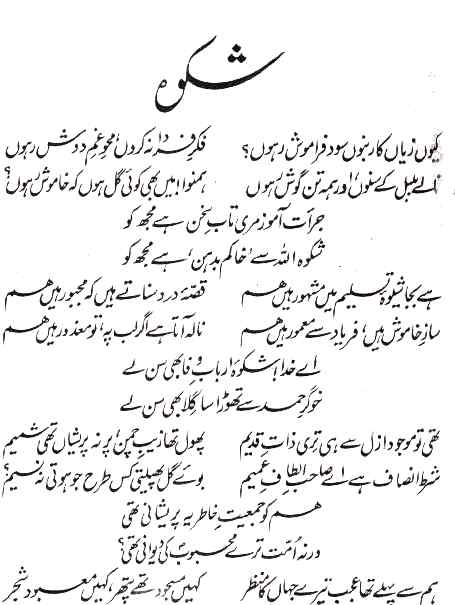
na atay humein is mein takrar kya thee
magar wada kartay hoay Arr kya thee
tumharay piyami ne sab raaz khola
khata is mein banday ke sarkar kya thee
bhari bazam mein apnay ashiq ko tara
teri ankh masti mein hushyar kya thee
tamal tou tha aun ko anay mein qasid
magar yea bata tarz-e-inkar kya thee
khinchay khood bakhood janeb-e-toor mosa
kashish teri ae shoq-e-dedar kya thee
kehein zikar rehta hay Iqbal tera
fasoon tha koi teri guftar kya thee
magar wada kartay hoay Arr kya thee
tumharay piyami ne sab raaz khola
khata is mein banday ke sarkar kya thee
bhari bazam mein apnay ashiq ko tara
teri ankh masti mein hushyar kya thee
tamal tou tha aun ko anay mein qasid
magar yea bata tarz-e-inkar kya thee
khinchay khood bakhood janeb-e-toor mosa
kashish teri ae shoq-e-dedar kya thee
kehein zikar rehta hay Iqbal tera
fasoon tha koi teri guftar kya thee
Tuesday, October 24, 2006
Courtesy: C---SiP---O
sunno,
wo jab sataata hay? kaha, dil doob jaata hay
kaho, dil doobta hay kab? bataya, jab sataata hay
kaho, kab phool khiltay hayn? kaha, jab muskuraata hay
dharakta dil hey kab bolo? kaha, jab paas aata hay
kaho, dil may hay kiya oskay? kaha, wo kab bataata hay
sunno, berham sa hay shayed? kaha, younhi banata hay
kaha, kuch to hua hoga? kaha, wo aazmata hay
buri shaey hay ishq kion ker? kaha, shab bhar jagaata hay
kaho, wo bazm kaisi thi? kaha, wo kab bulaata hay
kaho, os say bichernay ki? bicherna kisko bhaata hay?
kaho, milnay ki khawahish hay? kaha, bayderd naata hay
batao, raakh may hay kiya? sitara jhilmilata hay
larzz jati hayn kab palkein? nazar wo jab jamaata hay
theher jaati hay dharkan kab? nazar say jab giraata hay
sunno,
wo jab sataata hay? kaha, dil doob jaata hay
kaho, dil doobta hay kab? bataya, jab sataata hay
kaho, kab phool khiltay hayn? kaha, jab muskuraata hay
dharakta dil hey kab bolo? kaha, jab paas aata hay
kaho, dil may hay kiya oskay? kaha, wo kab bataata hay
sunno, berham sa hay shayed? kaha, younhi banata hay
kaha, kuch to hua hoga? kaha, wo aazmata hay
buri shaey hay ishq kion ker? kaha, shab bhar jagaata hay
kaho, wo bazm kaisi thi? kaha, wo kab bulaata hay
kaho, os say bichernay ki? bicherna kisko bhaata hay?
kaho, milnay ki khawahish hay? kaha, bayderd naata hay
batao, raakh may hay kiya? sitara jhilmilata hay
larzz jati hayn kab palkein? nazar wo jab jamaata hay
theher jaati hay dharkan kab? nazar say jab giraata hay
Friday, October 20, 2006
Peotry.........
********************************************************
Taray honton ke pholon ki chahut mein hum
dar ki khushk tehni pa waray gaey
taray hathon ki shamon ki hasrat mein hum
neem tareek rahon mein maray gaeu
soolion per humaray labon say paray
taray honton ki lali lapakti rehee
teree zulfon ki masti barasti rehee
taray hathon ki chandi damakti rehee
jab ghuli teree rahon mein sham-e-situm
hum chulay aaey jehan tuk laey qadam
lab pe harf-e-ghazal dil mein qindeel-e-gham
apna ghum tha gawahi taray husn ki
dekh qaim rehay is gawahi pay hum
hum jo tareek rahon mein maray gaey
narasai ager apni taqdeer thee
teree ulfut to apni he tadbeer thee
kis ko shikwa ger shoq ke silsilay
hijr ki qatal gahon say sub ja milay
qatal gahon se chun ke hamaray alam
aur niklein gay ushaq ke qaflay
jin ke rah-e-talab se hamaray qadam
mukhtasir ker chulay durd ke faslay
ker chulay jin ki khatir jehangeer hum
jan ganwa ke teree dilbari ka bharam
hum jo tareek rahon mein maray gaey
***********************************************************
Experts create invisibility cloak
| By Paul Rincon Science reporter, BBC News |

A US-British team of scientists has successfully tested a cloak of invisibility in the laboratory.  The cloak is constructed from advanced "metamaterials"
The device mostly hid a small copper cylinder from microwaves in tests at Duke University, North Carolina.
It works by deflecting the microwaves around the object and restoring them on the other side, as if they had passed through empty space.
But making an object vanish before a person's eyes is still the stuff of science fiction - for now.
The cloak consists of 10 fibreglass rings covered with copper elements and is classed as a "metamaterial" - an artificial composite that can be engineered to produce a desired change in the direction of electromagnetic waves. 
Prof John Pendry, Imperial College London


Like visible light waves, microwaves bounce off objects, making them apparent and creating a shadow. But at microwave frequencies, the detection has to be made by instruments rather than the naked eye.
New chapter
Water behaves differently. When water in a river flows around a smooth rock, the water closes up on the opposite side. Someone looking at the water downstream would never guess it had passed around an obstacle.
The metamaterial cloak channelled the microwaves around the object like water flows around the rock.
"These metamaterials have opened a new chapter in electromagnetism. We've opened the door into the secret garden," co-author Professor John Pendry, from Imperial College London, told BBC News.  Scientists were able to watch waves bending around the cloak
In the experiment, the scientists first measured microwaves travelling across a plane of view with no obstacles. Then they placed a copper cylinder in the same plane and measured the disturbance, or scattering, in the microwaves.
Next, the researchers placed the invisibility cloak over the copper cylinder. The cloak did not completely iron out the disturbance, but it greatly reduced the microwaves being blocked or deflected.
Hidden from view
"This cloak guides electromagnetic waves around a central region so that any object at all can be placed in that region and will not disturb the electromagnetic fields," explained co-author Dr David Schurig from Duke University.
"There is reduced reflection from the object, and there is also reduced shadow."
In principle, the same theoretical blueprint could be used to cloak objects from visible light. But this would require much more intricate and tiny metamaterial structures, which scientists have yet to devise.
"As an application, it's not clear that you're going to get the invisibility that everyone thinks about - as in Harry Potter's cloak, or the Star Trek cloaking device," said Professor David R Smith of Duke.
Broad applications
John Pendry commented: "There's a rule about the internal structure of the metamaterial: it has to be smaller than the wavelength of radiation. So for radar waves that's 3cm. You can easily engineer something a few millimetres across.
"You go up to optical radiation - visible light - and the wavelength is less than a micron. So your microstructure has to be a few tens of nanometres across. and we're only just learning how to do nanotechnology... maybe in five or 10 years' time you could do this, but not today."
The researchers say that if an object can be hidden from microwaves, it can be hidden from radar - a possibility that will ensure interest from the military.
Professor Pendry said a metamaterial cloak could be manufactured to wrap around a fighter plane or tank. But, he said: "You mustn't demand that the cloak be too thin. Despite the hype around Harry Potter, this isn't anything that flaps around in the breeze; it's more like a shed."
It could be used to hide objects from terahertz waves, a regime that is being exploited for numerous sensing technologies, or even from mobile phone frequencies and magnetic fields.
Subscribe to:
Posts (Atom)